Showing posts with label Reading. Show all posts
Showing posts with label Reading. Show all posts
Sunday, 24 November 2019

Monday, 5 August 2019
Cook Island Language Week

Cook Island Language Week

KIA ORANA!
Factsheet.pdf
 Video of "A God Given Language."- https://www.youtube.com/watch?time_continue=6&v=i83zP-FAqaw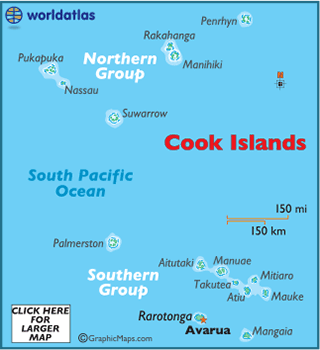
The warmth of the tropical sun envelops you, the scent of frangipani washes over you, the most pressing decision that you face, should you climb the summit of the islands majestic volcanic peak or explore the crystal clear turquoise waters and swim with schools of tropical fish. Either way you know you’ll enjoy your day in this tropical paradise we call The Cook Islands.
Uncover more about our people and our history.As modern Pacific people, high-spirited Cook Islanders are a cosmopolitan blend of western influence and ancient Polynesian heritage. Like any true blooded Maori, we enjoy pomp, splendor and big ceremonies with traditional customs and much feasting. Hospitality, smiles and a warm welcome come naturally.
After stopovers from Spanish explorers Alvaro de Mendana sighting Pukapuka in 1595, and Pedro Fernandez de Quiros sighting Rakahanga in 1606, Captain James Cook sighted Manuae in 1773, then subsequently Palmerston, Takutea, Mangaia and Atiu, where Lieutenant Gore landed in 1777. The redoubtable Captain William Bligh first sighted Aitutaki in 1798 and soon after, following the very bloody Mutiny on the Bounty, the buccaneer Fletcher Christian, having seconded Captain Bligh’s very own boat, sailed into Rarotonga.
Fun Facts!
- The Cook Islands are the world’s second largest producer of black pearls.
- While soccer and cricket are widely played all over the Cook Islands, rugby is the most popular and widely played sport.
- 13,095 people live on Rarotonga, making it the most densely populated island of all 15.
- The Cook Islands are known for their wood carving, and many young people who live here are taught by older generations of wood carvers how to perfect their skill
- The currency here is the New Zealand Dollar; however, they also use their own distinctive notes and coins.
Bibliography-Thursday, 15 March 2018
Subscribe to:
Posts (Atom)